A sculptor's first London show, ten years in the making.
Stone, salt, and a single year-long preparation. The show is one room and seven pieces. The preparation, the sculptor tells me, was the work.
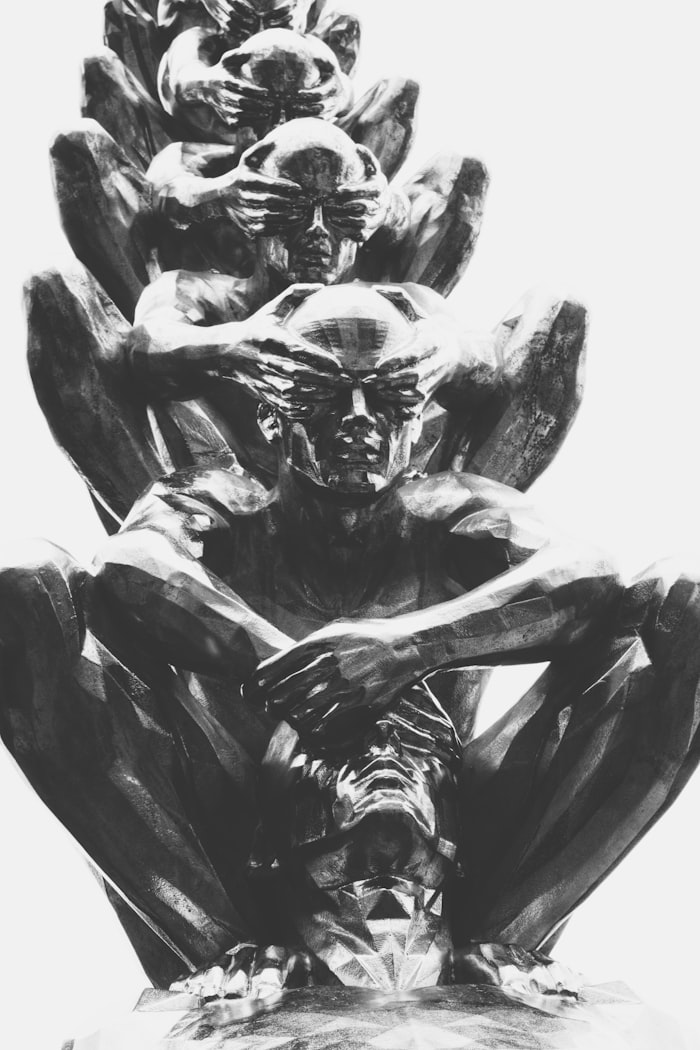
The sculptor has been making work, full-time, since 2014. She has shown it, in the period since, in two small exhibitions — one in the Netherlands, where she trained, and one in a regional museum in the south-west of England, where her tutor's friend had once been a curator. Neither show received any significant attention. Both, she says, were satisfying. The London show, which opened last week and runs for another fortnight, is her first in the city, and it has — by the modest standards of a small project space — already attracted a level of interest that her previous work has not.
The show is one room, seven pieces, no captions, and a single small printed sheet at the entrance giving the title of the exhibition and a list of materials. The materials, listed in the order the pieces appear in the room, are: limestone, sandstone, salt, marble, salt, limestone, salt. The titles of the pieces are not given. The sculptor does not, in conversation, refer to them by title. She refers to them, instead, by the order in which they were made.
What is in the room
The pieces range in scale from a piece small enough to hold in two hands to a piece that occupies roughly two cubic metres. None of them is, on a quick reading, decorative. They are not arranged on plinths in the conventional way. Three of them sit directly on the floor. Two are on low concrete blocks of the sculptor's own making. One hangs from a single steel cable from the ceiling, at a height that varies, by a few centimetres, with the temperature of the room. One — the smallest piece — sits on a small steel shelf that has been built into the wall at the height of the average viewer's eye.
The salt pieces are the ones that draw the most attention, on a first visit. They are large, irregular forms cut from blocks of rock salt sourced from a working mine in Cheshire. The salt is translucent in places, opaque in others, and — in the gallery's slightly warm lighting — appears to shift in colour as the viewer moves around it. The salt is also, of course, slowly dissolving. The sculptor has stated, in the small printed sheet, that the salt pieces will not survive the show. They will be replaced, in successive iterations of the exhibition, with new salt pieces cut from the same block.
What the preparation was
I spent forty minutes talking with the sculptor at the opening. She is, by her own description, a slow worker. The seven pieces in the show have been made over the course of the past eighteen months. The preparation — by which she means the thinking, the drawing, the small models, the conversations with her tutor and with a small number of trusted other sculptors — has, however, been going on for ten years.
This is, on the face of it, an alarming statistic. Ten years of preparation for seven pieces of work suggests, to the casual reader, either an impractical perfectionism or a kind of working method that no contemporary art economy can sustain. The sculptor is sanguine about both readings. She has, she says, supported herself in the period with a combination of teaching, occasional commissions for civic clients, and a modest inheritance that has kept the rent paid. She has not, in the ten years, felt the pressure to produce work for exhibition. The show is, in that sense, what the preparation was for.
"The pieces are the work, but the preparation was also the work. I don't, in honesty, know how to separate them."
What the room asks of the viewer
The show is, in the precise sense, demanding. It is not, however, demanding in the way that contemporary sculpture shows often are. It does not require the viewer to bring a knowledge of recent art history, or to identify the references the work is in conversation with, or to read a wall text that explains what they are looking at. It requires, instead, that the viewer spend time in the room, looking at the seven pieces, in something like the order the sculptor made them.
I spent, on my first visit, about forty-five minutes in the room. I returned the following morning and spent another hour. The pieces, on the second visit, were not quite the same pieces. The salt pieces had, in the intervening twenty-four hours, lost a small but visible amount of their material to the air. The other pieces — the stones — had, I think, settled slightly in their positions, though I am not entirely sure this is true. What was certainly true was that I was looking at them, on the second visit, with a different kind of attention than on the first.
What I would say about the work
I am going to resist the temptation to make a larger argument about what the show "means." The sculptor has spent ten years preparing for it. It would be presumptuous of me to summarise, in a paragraph, what she has spent ten years thinking about. What I will say is this: the show is one of the most carefully made bodies of recent sculpture I have encountered. The pieces are, individually, modest in their ambitions. Collectively, in the room, they amount to something I do not have a good word for, but which has stayed with me — clearly, and at full intensity — for the eleven days since I first saw it.
This is, in the end, what reviews of this kind are for. The work has been made; the work is in the room; the work will remain in the room for another two weeks. If you can be in London before the show closes, you should go. The room is small. The opening hours are limited. The attention is well rewarded.