The gallerist who only opens by appointment.
One room, one show at a time, one visitor at a time. A short conversation about the economics, the logistics, and the slightly perverse pleasure of running a contemporary gallery that almost nobody can casually walk into.
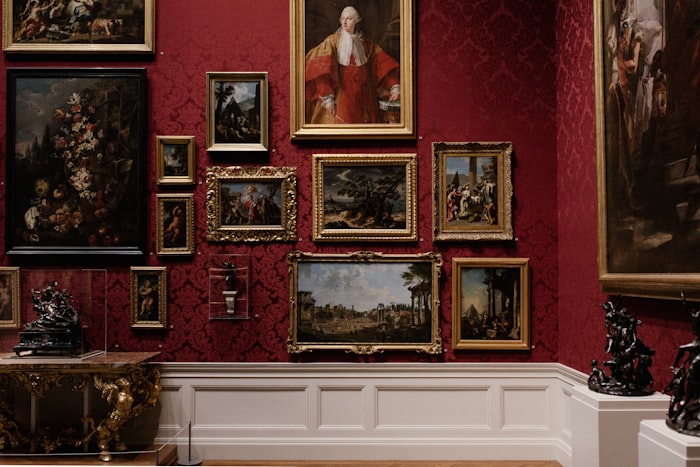
The gallery is on the first floor of a small building in a quiet part of a Midlands market town. There is no sign on the door. The door itself is unlocked only on Tuesdays and Thursdays, and only when a visitor has booked an appointment, in advance, by email. There is, when one arrives, a small bell. The gallerist comes down to open the door. The visit, by convention and by design, lasts somewhere between forty-five minutes and an hour and a half.
The gallery has been open since 2018. It has, by my count from the listings on its modest website, hosted thirty-seven exhibitions in that time. Each exhibition is solo. Each runs for between four and eight weeks. Each is seen, the gallerist estimates, by between thirty and ninety visitors over the course of the run.
The conversation
Vero: Most people who run a contemporary gallery want as many visitors as possible. You have set up a model that essentially guarantees that you will have fewer. Why?
Gallerist: Because the work is better served by fewer visitors, and the visitors are better served by being the only ones in the room. Those are the two reasons. They are connected.
V: Can you say more about the first one?
G: The work I show, by and large, is not work that benefits from being seen in passing. It is work that asks for time, and for attention, and for the visitor to be able to walk back and forth across the room without negotiating around other people. A gallery that has a lot of foot traffic flattens out the experience of the work. The work becomes one of several things in the room — other visitors, other voices, the slight psychological pressure of being watched while one is looking. I wanted to make a gallery where the work was the only thing in the room.
V: And the second?
G: The visitor who books an appointment, travels to a small market town, and rings the bell on a Tuesday afternoon is a visitor who has, by definition, decided that this particular show is worth the trouble. They are not popping in. They are not just passing. They have made a decision. The kind of attention they bring is different from the kind of attention a casual visitor brings. The gallery, in a sense, selects its audience by the structure of its opening hours.
"The gallery selects its audience by the structure of its opening hours. The visitors who come are visitors who have decided that this particular show is worth the trouble."
V: Does the model work economically?
G: It works. Not lavishly. The gallery is, by intention, a small operation. I do not have staff. I do not have a press office. I do not exhibit at art fairs. The overheads are limited to the rent, the lighting, the insurance, and the cost of producing the small publications that accompany each show. The sales — which happen, for the most part, between me and a small core group of collectors who have built up trust with the programme over the years — cover the overheads and a modest income.
V: What about the artists? How do they feel about being shown to so few people?
G: Mixed. Most of the artists I show have, by the time we work together, given up on the high-foot-traffic model. They have shown at larger galleries and have been disappointed by how little of the work the casual visitor actually saw. They are usually relieved, when they first show with me, to find that the visitors are paying attention.
There is also, however, a financial question. The artists I show are not, in most cases, making a living from their art. They have other work. The sales that come from my gallery are modest. The model works for them in part because they are not depending on it. I am quite open about this with artists when we first start talking about a show. It is not for everyone.
V: Do you ever want more visitors?
G: Occasionally. There are shows where I have wished, after the fact, that more people had seen the work. There are artists whose careers, I think, would have benefited from a different kind of exposure than I was able to give. I am not, in either of those cases, certain that I would have wanted to run a different gallery. I have come to think of the gallery as a particular kind of instrument, and the instrument is the one that fits the work I want to show. Other galleries can do the other things.
V: What would you say to someone who was considering a similar model?
G: I would say that it is harder than it looks. The appointment model sounds quiet and considered, and it is. It is also lonely. There are weeks where I see two visitors, total. There are weeks where I write five emails to confirm appointments that the visitors then do not honour. The financial pressure is constant, even at the very modest level at which the gallery operates. I would not, on balance, do anything else, but I would not pretend that the work is in any way easier than running a more conventional gallery.
What I left thinking
The visit, when I had it, lasted about fifty minutes. The current show was a small body of work by a painter I had not previously encountered. The gallerist and I talked about the show for about fifteen of the fifty minutes, and the rest of the time I spent looking at the paintings on my own, with her sitting at a small desk in the corner of the room, working quietly on something else.
This is, I think, the part of the model that does not translate easily into the conventional art-writing summary. The visit is unusually intimate. The gallerist's presence in the room is unobtrusive but real. The visitor is held, lightly, in a working room rather than left, anonymously, in a public space. The effect on the viewing — at least, on my viewing — was substantial. I looked more carefully at the paintings, I think, than I would have done in a gallery with more visitors and less obvious staff. The relationship with the work was, briefly, my own.
The model is not, by the standards of contemporary commercial gallery practice, scalable. It is also not intended to be. It is, on its own terms, a working instrument. The gallerist has been running it for eight years. She intends, by her own account, to run it for as long as the work she wants to show is being made.